
Author: Muireann Ranta (OMEP President)
The extent and magnitude of the triple planetary crisis, comprising the climate
(UNCRC 2023, p.1)
emergency, the collapse of biodiversity and pervasive pollution, is an urgent and
systemic threat to children’s rights globally.


Children bear the most significant burden of climate change, as they are more vulnerable than adults to disease, extreme weather events or food insecurity, and because the planet itself is becoming unsafe (UNICEF, 2021). Furthermore, environmental harm has severe consequences for children under the age of 5. Their vulnerability to pollution and other hazards makes them more susceptible to health issues and even death. According to the World Health Organization (WHO) and the United Nations General Assembly (UNGA), environmental risks contributed to 1.5 million deaths of children under 5 in 2015, and many of these deaths could have been prevented with reduced exposure to environmental dangers.

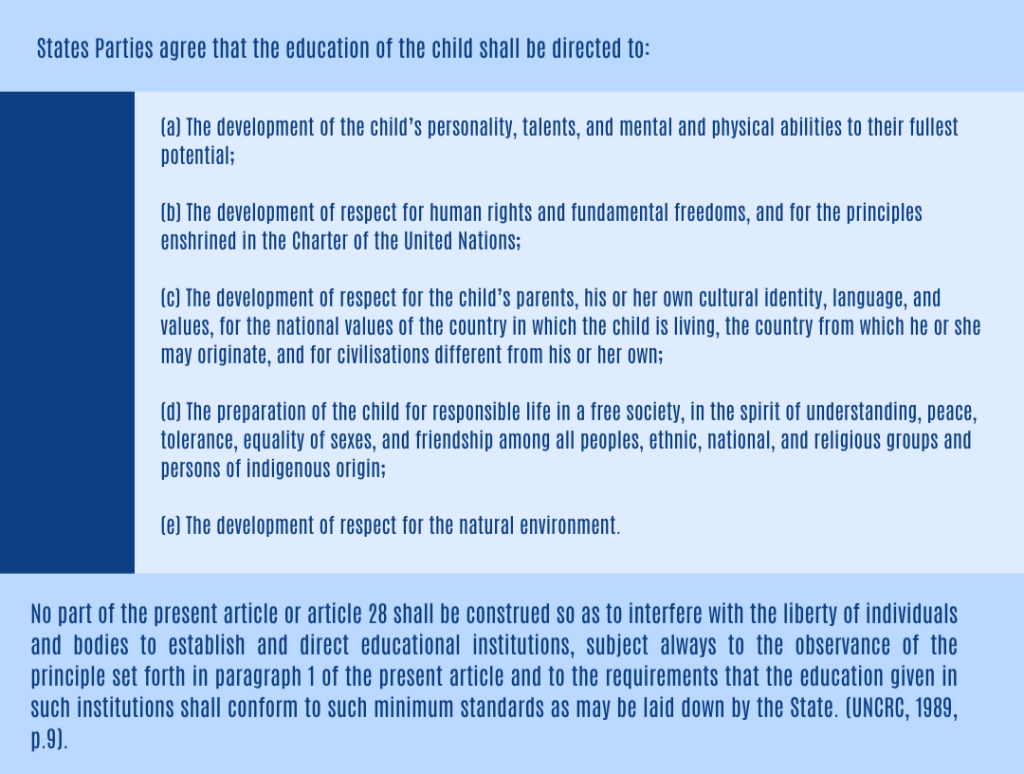
The United Nations Convention on the Rights of the Child (CRC, 1989) is a legally binding agreement that establishes the fundamental rights of all children. Taking force in 1990, it encompasses various civil, political, economic, social, and cultural rights. Under the CRC, a child is defined as any human being below the age of eighteen unless the law applicable to them grants them the status of majority earlier. Article 29 1 (e) of the CRC enshrines the right of all children to receive an education that develops respect for Nature as follows:
Education has been pinpointed as the tool needed to bring about the necessary changes in human behaviour and attitudes to combat this climate crisis (UNDP, 2015). The integral position of early education and care (ECEC) in promoting education for sustainable development (ESD) was initially stated in The Contribution of Early Childhood Education to a Sustainable Society (UNESCO, 2008) and subsequently in the OMEP Education for Sustainable Development in the Early Years reports (Siraj-Blatchford, Smith, and Pramling Samuelsson, 2010). The reports emphasise the importance of recognising young children as rights holders in their education spaces and implementing the CRC. They also define sustainability as an evolving concept, as various sustainability concerns are experienced by children worldwide. As such, a deep understanding of local cultural contexts is crucial for the effective and respectful application of ESD.
During the Decade of Education for Sustainable Development (DESD) (2005-2014), the OMEP World Project Early Childhood Education for Sustainability (2009-2015) examined an awareness of the sector’s role in ESD promotion with a particular focus on taking a child- oriented perspective (Engdahl, 2015). The report indicated that young children possess substantial knowledge about Nature and environmental issues and an understanding of individual responsibilities for sustainability. Findings also highlighted that adults frequently underestimate the competencies of young children in this regard. As part of the research, OMEP introduced the Environmental Rating Scale for Sustainable Development in Early Childhood (ERS-SDES) in 2013 (updated in 2019) to further assess ESD curricula development for the sector.
OMEP Ireland and ESD.
As part of a collaborative Erasmus+ project, with Kristianstad University, edChild and four OMEP partner countries (Sweden, France, Croatia and the Czech Republic), OMEP Ireland has been involved in developing a free online module for anyone interested in supporting ESD in ECEC since 2022. Sustainability from the Start integrates digital learning, ESD and ECEC, focusing on educators and young children. The overall aim is to promote awareness of sustainability-related issues, such as climate change and global warming, and the importance of taking action for transformative change towards a sustainable lifestyle.
As previously described, the early childhood years (birth to 8 years) represent an unparalleled and underutilised window of opportunity to instil long-lasting sustainability- related skills, attitudes, and habits. All of the Sustainable Development Goals (SDGs) impact babies, toddlers, young children and indeed future generations. Through this project, children, their families and educators can directly contribute to the implementation of SDG 4.2, which recognises the importance of early childhood education, and SDG 4.7 on sustainable development and global citizenship. The module includes activities related to many or all of the UN SDGS, thereby increasing knowledge about the goals and providing direct experience to contribute to their achievement.
Additionally, in collaboration with Munster Technological University and Research Ireland, OMEP Ireland is currently conducting a participatory action research (PAR) study with ECEC educators. Utilising a reflective online community of practice (CoP) platform, this study examines the challenges and opportunities in applying ESD principles in everyday EC practices. By providing a platform for educators to share their experiences and expertise on ESD, this study also explores the effectiveness of a CoP platform to empower educators in their ESD teaching roles, while also developing a resource authentic to the EC sector.
For more information on the CoP study,
follow this link